
Category: Uncategorized

  • Handing over a rental home: the inspection checklist

    Handing over a rental home: the inspection checklist

    If you give notice on a rented home, your tenancy agreement will say that you hand the property over broom clean, bezemschoon in Dutch. With almost every landlord that means the same thing: empty, clean, safe and undamaged, back in the condition in which you received it, apart from normal wear and tear. How strictly that is judged does vary. One inspector wants to see the property empty and swept, another walks round with a list and opens every cupboard.

    Whatever else your landlord asks of you is set out in the report from the pre-inspection.

    What does handing over broom clean mean?

    Empty means genuinely empty. No furniture, no boxes in the loft, no tins of paint in the storage room, no sofa left behind because the new tenant might want it. Clean goes further than sweeping: the inside of the cupboards and the edges count too. Most landlords expect the following:

    • The whole property swept, vacuumed and mopped, so the loft and the meter cupboard as well.
    • Kitchen and bathroom free of grease and limescale, including the inside of the cupboards and drawers and the extractor hood.
    • Window frames, window sills and skirting boards wiped down, with dust, grease, stickers and adhesive residue removed.
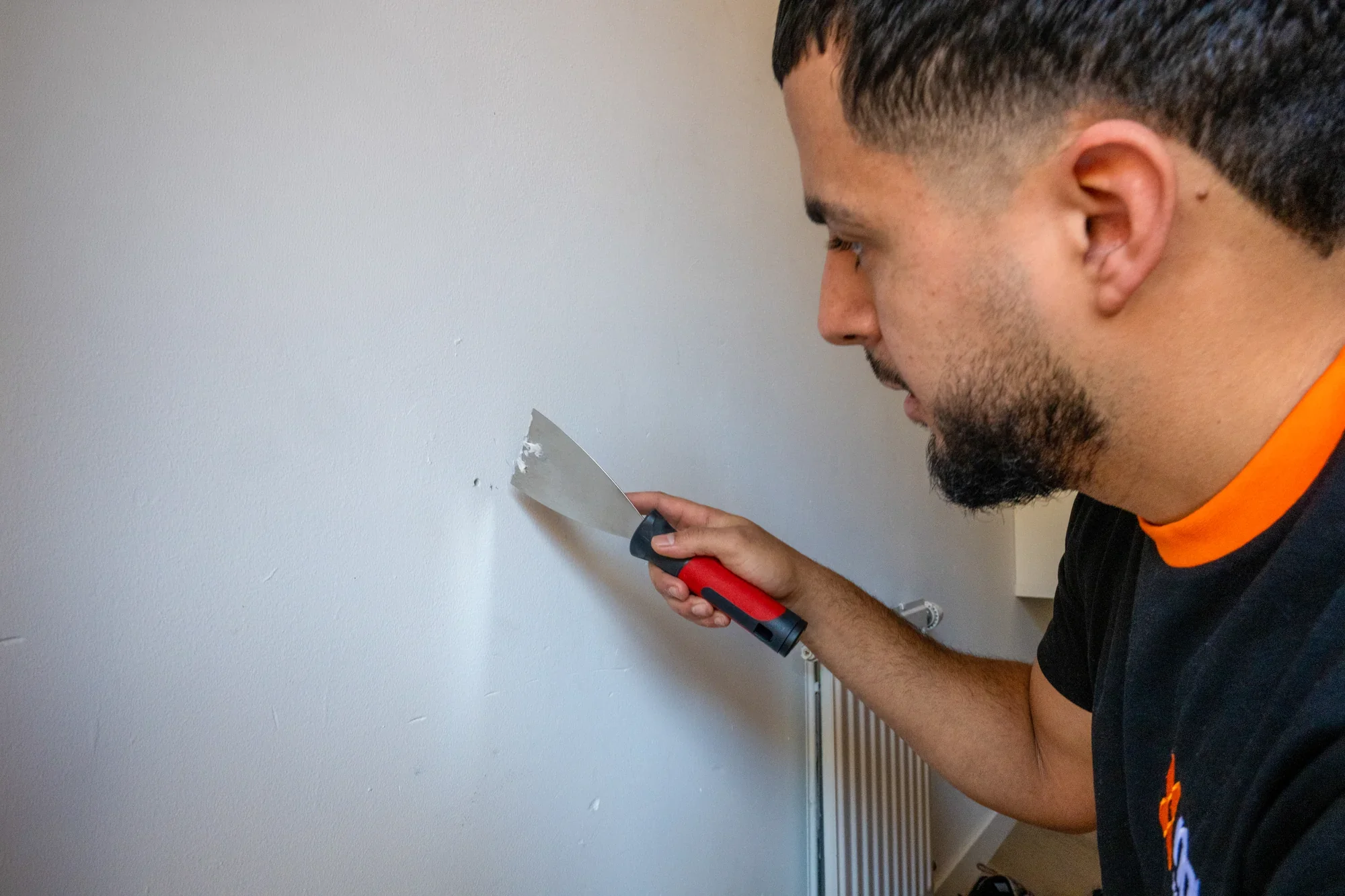
    • Hooks, rails and wall plugs out, the holes filled and no wires left loose.
    • Storage room, balcony and paving empty and swept, and the weeds pulled out.

    Where landlords differ is the repair work. One housing association asks you to fill screw holes but not to sand or paint. Another wants the wall flat and back in its original colour. That does not follow from the law but from your inspection report.

    The pre-inspection and the final inspection are two separate moments

    Many tenants think there is a single inspection. With a housing association, a woningcorporatie, there are almost always two, and it is the first visit that decides what you have to do.

    The pre-inspection: this is where the inspector draws up the list

    Shortly after you give notice, often within two weeks, an inspector calls round. You are there yourself and the property is still lived in. He goes through every room, decides what counts as normal wear and tear and what is down to you, and records that in an inspection report with photographs. You receive that report by email or in your tenant portal, and it sets out what may stay and what has to go.

    That report is what counts. If a point is not in it, your landlord can in principle not charge you for it at the final inspection either. If it is in there and you have not done it, the discussion is short. So read it straight away and ring if anything is unclear.

    The final inspection: only ticking off the list

    The final inspection takes place on or just before your last day of tenancy, in an empty property. The inspector goes through the report point by point, notes the meter readings and takes in all the keys. If something turns out to be still outstanding, there is no time left to do it yourself. The landlord has it carried out and sends you the bill. Those weeks between the two inspections are there precisely so that you can finish that work.

    Checklist: what do you take out before the handover?

    These are the points most often left undone. Go through them with your inspection report beside you, because not every landlord requires all of it.

    • Carpet and underlay come out, including tape and glue residue on the subfloor. Glue that has stuck fast has to come off with a scraper. Often the biggest job of all.
    • Laminate, skirting boards and thresholds out if the report asks for it. The skirting boards and the trims by the doors are almost always forgotten.
    • Wall plugs out and screw holes filled, finished flat. A plug you simply fill over shows.
    • Curtain tracks, poles and light fittings down, with the loose wires finished off with a connector block or a cover cap. A bare wire will be failed.
    • Garden cleared and hoed, paving swept and free of weeds. A planted strip along the front wall, a shed or decking that you put in yourself often has to come out.
    • Storage room, shed and loft completely empty. There is nearly always something still in there: old bicycles, leftover paint, planks, Christmas decorations.
    • Balcony and roof terrace empty and swept, including the decking, the wind screens and the planters.
    • Hand in every key you were ever given, plus any copies you had cut and the ones for the storage room and the letterbox. If one is missing, the lock is replaced at your expense.

    Handovers between the outgoing and the incoming tenant

    Sometimes the new tenant wants to take over your flooring, the curtains or a cupboard you fitted yourself. That is allowed, but not on a verbal agreement. With a housing association it goes through a handover form that you are given at the pre-inspection. On it you set out what is being taken over, you both sign it and you hand it in at the final inspection.

    The landlord can also refuse a handover, for instance because something is not technically sound, or because with a fixed floor it first has to be established what lies underneath. And as long as the form has not been signed, it remains your responsibility: if the new tenant pulls out at the last moment, that floor still has to come up.

    If anything is left behind without an agreement, the landlord removes it. The hours, the disposal costs and the cleaning go onto your final statement. The same applies if the property is not broom clean. The landlord charges that as work, not as a penalty.

    Arrange it yourself or let the landlord invoice you?

    What a landlord charges for repairs is not published and you usually only hear about it on the final statement. What you do know in advance is what it costs to have the property emptied and handed over in one go:

    • Studio or small flat. From € 500.
    • Terraced or family home. € 1.000 to € 1.750.
    • Detached house or large property. € 1.750 to € 3.000 or more.

    That covers the emptying, the sorting, the removal and the broom clean handover with photographs and a handover report. Doing it yourself is cheaper if you have the time and can borrow a trailer. In that case reckon on trips to the municipal recycling centre, tipping charges per cubic metre and a few full days of work. How a fixed price is built up is set out under house clearance. If the date is tight, for example after a death, have a look at house clearance after a death or emergency clearance.

    Prefer one firm to arrange the handover

    We empty rented homes and hand them over broom clean, with photographs and a handover report that you can give to your landlord. Carpet, laminate, skirting boards, curtain tracks and light fittings are taken on in the same job, as long as you mention them at the survey. Anything still usable goes to a second-hand shop or a charity, and the rest we separate into wood, metal, plastic and electronics.

    In the area around Gouda and Woerden we come across tenants of Mozaïek Wonen, Woonpartners Midden-Holland, GroenWest, Woonforte, De Goede Woning, Vidomes, Stedelink, Portaal and Cazas Wonen, among others. The requirements they set differ from one association to the next and from one property to the next. Send us your inspection report and we will work through the points it lists.

    Would you like to know what emptying your property and handing it over will cost? Request a free survey through the contact page or call 085 7444 039. We usually call round within 1 to 3 working days and within 24 hours after that you have a fixed price, with no extra charges afterwards.


  • Clearing a home after a death: a step-by-step guide

    Clearing a home after a death: a step-by-step guide

    After a death the property has to be emptied at some point. With a rented home a deadline is running, and with a privately owned home the estate agent wants the house empty before it goes on the market. At the same time there is a great deal else to arrange and you do not want to throw away anything you will regret later.

    The order matters. Whatever has a deadline attached, you arrange straight away. The contents can nearly always wait, and should wait until it is clear how you accept the estate.

    What has to come first, and what can wait

    In the first few days the attention goes to the funeral and the paperwork that comes with it. The property can almost always wait. Start with the matters that have a deadline attached and leave the contents where they are.

    • Registering the deathThe funeral director usually registers the death. Ask for extra death certificates straight away, because banks, insurers and the landlord all want one.
    • Certificate of inheritanceThe notary establishes who the heirs are and who may act on their behalf. Many banks and landlords will only do business with you once this document, the verklaring van erfrecht, is in place.
    • Informing the landlord or estate agentWith a rented home a deadline starts running from the day of death. So report it quickly, even if you do not yet know when the property can be emptied.
    • Post and subscriptionsHave the post redirected to your own address and cancel any running subscriptions.

    Sorting through the contents and having them removed can wait. There is rarely any hurry behind it, and starting too early can mean that you accept the estate outright.

    Heirs, executor and notary

    The heirs are jointly responsible for the estate, the nalatenschap. As long as nothing else has been arranged, they have to agree together on what happens to the property and the contents.

    If the will names an executor, the position is different. An executor may administer the estate and in practice often arranges the clearance, the notice on the tenancy and the contact with official bodies. The notary draws up the certificate of inheritance. On the legal side the notary takes the lead, so questions about accepting an estate, debts or powers to act belong there.

    Wait before throwing anything away until the estate has been accepted

    Before you take belongings, sell them or have them removed, it has to be clear how you accept the estate. You can become liable for the debts of the deceased without meaning to.

    Accepting outright

    You receive everything there is, but you are also liable for all the debts. According to the Rijksoverheid, the Dutch government, that holds even when those debts together come to more than the assets. The shortfall then comes out of your own money. You do not have to file anything with the court for this.

    Accepting beneficially

    You do accept the estate, but you are not liable for the debts. The debts are paid out of the estate first, and whatever is left goes to the heirs. For this you make a declaration at the court. The settlement then follows fixed rules, which means more work and more cost. If you do not know whether there are debts, this is the cautious route.

    Emptying a property can count as an act of acceptance

    You do not have to sign anything to accept an estate outright. Your conduct can be enough in itself. The Rijksoverheid puts it like this: if you take belongings of the deceased or sell them, or if you pay outstanding bills, then in law you have accepted the estate outright. Paying for the funeral out of the estate does not fall under this.

    Emptying a property and dividing or selling the contents can therefore be seen as an act of acceptance. There is no statutory deadline for the decision itself, so do not let yourself be rushed. Have your situation assessed by the notary before any belongings leave the house. We only remove anything once the heirs or the executor give the go-ahead.

    The notice period for a rented home

    If the deceased lived alone, without a co-tenant and without a lasting shared household with another occupant, the tenancy agreement ends by itself. The main rule is that the tenancy ends at the end of the second month after the death. So if someone dies on 18 March, the tenancy runs until 31 May.

    The heirs may give notice earlier, with effect from the end of the first month. That saves a month of rent, but the property then has to be handed over a month earlier as well. If someone does stay on, a co-tenant or a child living at home for instance, different rules apply. Check that with the landlord.

    What the landlord expects at the handover

    If the heirs accept the estate, they are responsible for a proper handover. If all the heirs renounce the estate, that falls to the landlord, according to the Woonbond, the Dutch tenants’ association. Exactly what has to be done differs from one landlord to another, but almost all of them come back to this:

    • Ask for a preliminary inspectionThe landlord sets out in a report which work is required, with an indication of the costs. That way you know in advance where you stand.
    • Empty and broom cleanStoreroom, loft, shed and balcony included.
    • Your own alterations taken outCarpet, laminate, skirting boards, curtain rails and light fittings are often removed, and holes and plugs filled. Whatever may stay is set out in the report.
    • Record everything with photographsPhotograph the condition in which you leave the property. That is your evidence in any discussion about repair costs.

    At the final inspection you go through together whether the agreed work has been done.

    Papers, photographs, jewellery and valuables

    These are the belongings that mean most to the family and that cause discussion most often. Agree in advance how you will handle them, certainly if there are several heirs.

    • Papers firstGather policies, bank statements, deeds, tax papers and post in one place. Do not throw paperwork away before the estate has been settled.
    • Photographs and albums apartPhotographs have no monetary value. For the family they are often the most important thing in the property. Look through them calmly at home, not on the day of the clearance itself.
    • Jewellery and valuablesRecord with a photograph and a list what has been found. Hand it over to the executor or to the heirs together.
    • Do not throw away anything you are unsure aboutIf in doubt, set something aside rather than put it in the skip, because once something has been taken away you cannot get it back.

    Arranging a clearance when you live far away

    Many children no longer live in the place where their parents lived. That need not be a problem: most families come round once at most.

    • A survey by videoIf you cannot be there, we walk through the property on a video call. You see every room with us and say there and then what has to stay.
    • Photographs to consult you during the workAnything we are unsure about is photographed and sent to you. Only once you agree does it go with us or go away.
    • The key through the notary or estate agentWe collect the key from the notary, the estate agent or the housing association and hand it back in there as well.
    • A handover with photographs and a reportAfterwards you receive photographs of the empty property and a handover report for the landlord, estate agent or notary.

    The order to work in

    Arrange the funeral and the paperwork first. Have the notary establish who decides what and how you accept the estate. Only after that does the property get emptied.

    You can read how we handle this in practice on the page about house clearance after a death. If it concerns a clearance without a death, have a look at house clearance. We work from Bodegraven across the whole Groene Hart region, including in Gouda and Alphen aan den Rijn.

    If you have a question or would like to book a free survey, you can contact us or call 085 7444 039. The survey is usually possible within 1 to 3 working days, and after that you have a fixed price within 24 hours.

  • What does a house clearance cost?

    What does a house clearance cost?

    A house clearance costs between € 500 and € 3.000. For a studio or small flat it starts at € 500, a terraced or family home usually sits between € 1.000 and € 1.750, and a detached house or a large property comes out at € 1.750 to € 3.000 or more. Where you land within that range depends on four things: how much is in the property, how easy the building is to reach, how much extra work the handover calls for and whether it has to be done at short notice.

    We do not give a price per square metre. Two homes of the same size can be far apart in terms of work: one still holds half its contents, in the other the loft has not been cleared in thirty years. That is why someone from our team comes round, walks through the property with you, and you then get one fixed amount.

    Guide prices per type of property

    These amounts apply to a complete clearance: sorting, carrying out, removal, processing and handing the property over broom clean, the standard Dutch handover condition.

    Type of propertyGuide price
    Studio or small flatfrom € 500
    Terraced house or family home€ 1.000 to € 1.750
    Detached house or large property€ 1.750 to € 3.000 or more

    If the flat is already half empty, you come out near the lower end. For a family home with a full shed, a garage and a loft stacked with boxes, the amount runs above the upper end. You hear that at the survey, so it does not turn up on the invoice afterwards. Within our service area we do not charge call-out costs: whether the property is in Bodegraven or in Gouda, the rate is the same.

    What determines the price of a clearance?

    Four points account for almost the whole price. If you know them, you can work out for yourself roughly where a property will land.

    How much there is to clear

    This weighs heaviest. The price depends on the number of cubic metres that has to leave the property and then be processed, not on the floor area. People who make their own estimate nearly always forget the same places: the loft, the cellar, the shed, the garage and whatever is standing at the back of the garden. More volume means more people, more trips and higher tipping charges.

    How easy the property is to reach

    A ground-floor flat where the lorry can stand at the door is empty sooner than a third floor without a lift. At the survey we look at the stairs and the stairwell, at the dimensions of the lift, and at whether we may load and unload or first need a permit from the council. In an old town centre with narrow streets, the same volume takes more hours.

    Extra work at the handover

    Many requests go further than emptying. A landlord or buyer often wants the floors taken out, curtain rails and light fittings removed and plugs and screw holes filled. Glued-down carpet and laminate with adhesive residue take the most work. If you mention this at the survey, it is part of the fixed price.

    Whether it has to be done at short notice

    We normally schedule a clearance within one to two weeks. If the property has to be empty within 24 to 48 hours, for instance because the handover of keys is already fixed, we put in extra people and an extra vehicle. That costs more than spreading the same work over two days. On the emergency clearance page you can read how we handle that.

    What is and is not included in the price?

    The fixed price covers everything from the full property to the broom clean handover:

    • Sorting and setting aside. Usable furniture goes to a second-hand shop or a charity, and papers, photographs and personal belongings are put aside in boxes.
    • Carrying out and removal, including the manpower, the equipment, the lorry and the trips to the processing plants.
    • The rest we separate into wood, metal, plastic and electronics. Those tipping charges are part of the amount.
    • A broom clean handover, storeroom and balcony included, with photographs of the empty property and a handover report for the estate agent, notary or landlord.

    We do not remove asbestos ourselves. In properties built before 1994 it is still found regularly, for instance in a shed roof or in carpet adhesive, and only a certified removal firm may take it out. At the survey we point out what is suspect and we schedule the clearance straight after the removal work. Those removal costs run through that company and stand apart from our price.

    If something comes up during the work that we did not discuss at the survey, for instance a garage that was locked, you hear what that costs first.

    How we arrive at a fixed price

    We only set the price once someone from our team has stood in the property. Over the telephone we could do no more than guess at it.

    • The survey on site is free and usually possible within 1 to 3 working days. We walk through every room, loft, shed and garage included.
    • Within 24 hours after that, the fixed price is on paper, setting out what we take away and what we hand over. For private customers that amount includes VAT.
    • No after-calculation follows: no hourly rate, no surcharge per cubic metre and no tipping charges added later on.
    • We agree the schedule with you. The clearance usually falls within one to two weeks.

    Can a house be emptied free of charge in exchange for the contents?

    We are asked this often, usually in the form of having a house emptied free of charge after a death. With us that is not possible: we do not buy contents and we do not offset anything against the price. You get a fixed price for the work, and what happens to the belongings stands apart from that.

    Removal costs money. For every cubic metre that goes to a processing plant we pay tipping charges, and the people who empty the property have to be paid for that day. So the contents would have to fetch a great deal before that was covered. In most homes there is no question of that: tidy contents from the eighties or nineties fetch next to nothing second hand, and for a second-hand shop a three-piece suite, a dining set and a cabinet of crockery are more work than return.

    If someone does promise you a free clearance, that company earns its money elsewhere: on a high basic amount, on costs that only appear on the final invoice, or by dumping belongings unsorted. If you can see belongings of real trade value in your own home, antiques or good tools for instance, sell those yourself and say at the survey what is staying. That saves volume, and volume sets the price.

    A price for your situation

    A range tells you whether you are in the right order of magnitude. For the exact amount, one visit is enough. On the house clearance page you can read what we do and how a clearance runs from start to finish. You can book a survey by telephone on 085 7444 039 or through the contact page. Please state what sort of property it concerns and when it has to be empty, then we know straight away whether that date is achievable.