
If you give notice on a rented home, your tenancy agreement will say that you hand the property over broom clean, bezemschoon in Dutch. With almost every landlord that means the same thing: empty, clean, safe and undamaged, back in the condition in which you received it, apart from normal wear and tear. How strictly that is judged does vary. One inspector wants to see the property empty and swept, another walks round with a list and opens every cupboard.
Whatever else your landlord asks of you is set out in the report from the pre-inspection.
What does handing over broom clean mean?
Empty means genuinely empty. No furniture, no boxes in the loft, no tins of paint in the storage room, no sofa left behind because the new tenant might want it. Clean goes further than sweeping: the inside of the cupboards and the edges count too. Most landlords expect the following:
- The whole property swept, vacuumed and mopped, so the loft and the meter cupboard as well.
- Kitchen and bathroom free of grease and limescale, including the inside of the cupboards and drawers and the extractor hood.
- Window frames, window sills and skirting boards wiped down, with dust, grease, stickers and adhesive residue removed.
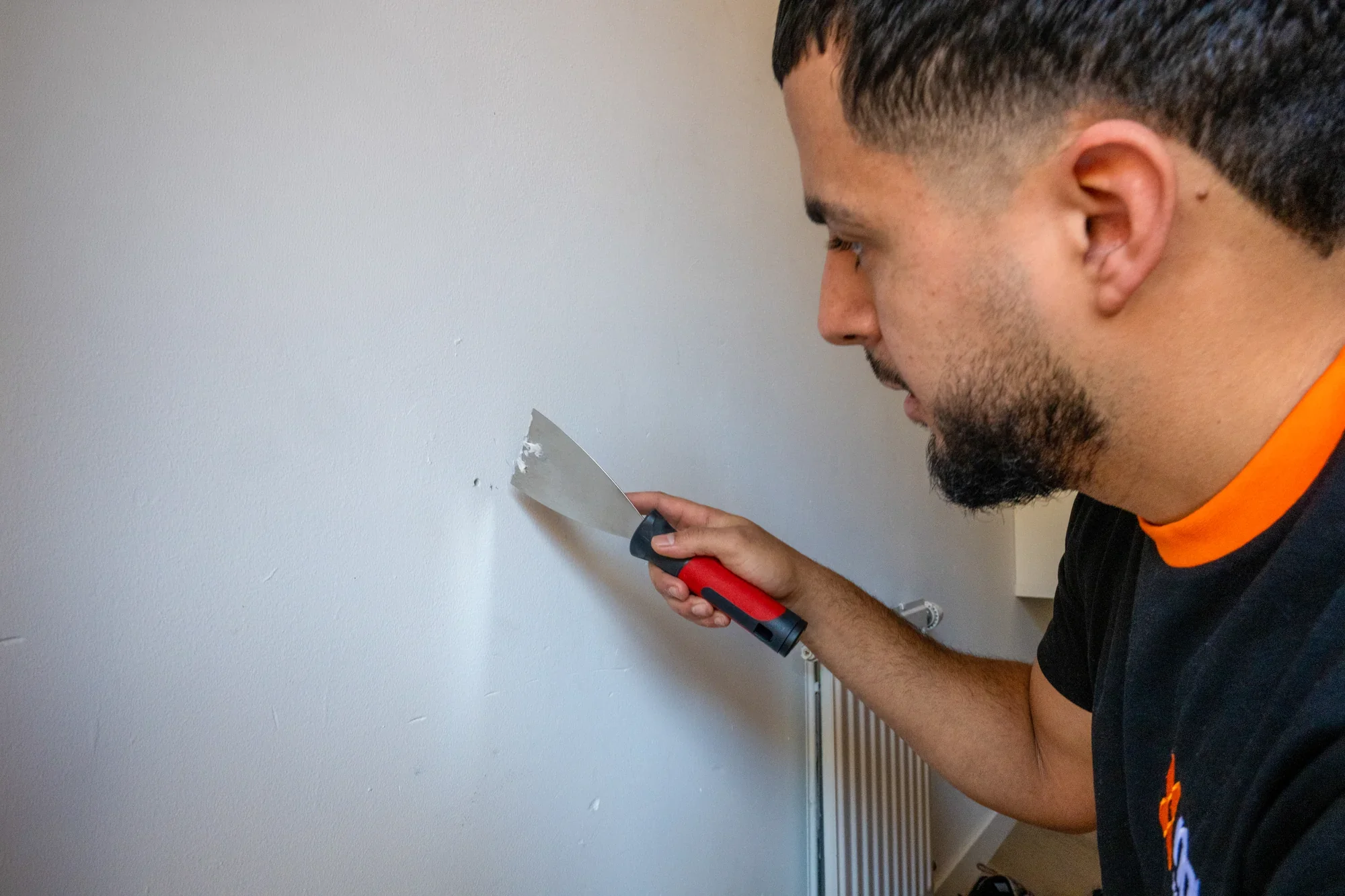
- Hooks, rails and wall plugs out, the holes filled and no wires left loose.
- Storage room, balcony and paving empty and swept, and the weeds pulled out.
Where landlords differ is the repair work. One housing association asks you to fill screw holes but not to sand or paint. Another wants the wall flat and back in its original colour. That does not follow from the law but from your inspection report.
The pre-inspection and the final inspection are two separate moments
Many tenants think there is a single inspection. With a housing association, a woningcorporatie, there are almost always two, and it is the first visit that decides what you have to do.
The pre-inspection: this is where the inspector draws up the list
Shortly after you give notice, often within two weeks, an inspector calls round. You are there yourself and the property is still lived in. He goes through every room, decides what counts as normal wear and tear and what is down to you, and records that in an inspection report with photographs. You receive that report by email or in your tenant portal, and it sets out what may stay and what has to go.
That report is what counts. If a point is not in it, your landlord can in principle not charge you for it at the final inspection either. If it is in there and you have not done it, the discussion is short. So read it straight away and ring if anything is unclear.
The final inspection: only ticking off the list
The final inspection takes place on or just before your last day of tenancy, in an empty property. The inspector goes through the report point by point, notes the meter readings and takes in all the keys. If something turns out to be still outstanding, there is no time left to do it yourself. The landlord has it carried out and sends you the bill. Those weeks between the two inspections are there precisely so that you can finish that work.
Checklist: what do you take out before the handover?
These are the points most often left undone. Go through them with your inspection report beside you, because not every landlord requires all of it.
- Carpet and underlay come out, including tape and glue residue on the subfloor. Glue that has stuck fast has to come off with a scraper. Often the biggest job of all.
- Laminate, skirting boards and thresholds out if the report asks for it. The skirting boards and the trims by the doors are almost always forgotten.
- Wall plugs out and screw holes filled, finished flat. A plug you simply fill over shows.
- Curtain tracks, poles and light fittings down, with the loose wires finished off with a connector block or a cover cap. A bare wire will be failed.
- Garden cleared and hoed, paving swept and free of weeds. A planted strip along the front wall, a shed or decking that you put in yourself often has to come out.
- Storage room, shed and loft completely empty. There is nearly always something still in there: old bicycles, leftover paint, planks, Christmas decorations.
- Balcony and roof terrace empty and swept, including the decking, the wind screens and the planters.
- Hand in every key you were ever given, plus any copies you had cut and the ones for the storage room and the letterbox. If one is missing, the lock is replaced at your expense.
Handovers between the outgoing and the incoming tenant
Sometimes the new tenant wants to take over your flooring, the curtains or a cupboard you fitted yourself. That is allowed, but not on a verbal agreement. With a housing association it goes through a handover form that you are given at the pre-inspection. On it you set out what is being taken over, you both sign it and you hand it in at the final inspection.
The landlord can also refuse a handover, for instance because something is not technically sound, or because with a fixed floor it first has to be established what lies underneath. And as long as the form has not been signed, it remains your responsibility: if the new tenant pulls out at the last moment, that floor still has to come up.
If anything is left behind without an agreement, the landlord removes it. The hours, the disposal costs and the cleaning go onto your final statement. The same applies if the property is not broom clean. The landlord charges that as work, not as a penalty.
Arrange it yourself or let the landlord invoice you?
What a landlord charges for repairs is not published and you usually only hear about it on the final statement. What you do know in advance is what it costs to have the property emptied and handed over in one go:
- Studio or small flat. From € 500.
- Terraced or family home. € 1.000 to € 1.750.
- Detached house or large property. € 1.750 to € 3.000 or more.
That covers the emptying, the sorting, the removal and the broom clean handover with photographs and a handover report. Doing it yourself is cheaper if you have the time and can borrow a trailer. In that case reckon on trips to the municipal recycling centre, tipping charges per cubic metre and a few full days of work. How a fixed price is built up is set out under house clearance. If the date is tight, for example after a death, have a look at house clearance after a death or emergency clearance.
Prefer one firm to arrange the handover
We empty rented homes and hand them over broom clean, with photographs and a handover report that you can give to your landlord. Carpet, laminate, skirting boards, curtain tracks and light fittings are taken on in the same job, as long as you mention them at the survey. Anything still usable goes to a second-hand shop or a charity, and the rest we separate into wood, metal, plastic and electronics.
In the area around Gouda and Woerden we come across tenants of Mozaïek Wonen, Woonpartners Midden-Holland, GroenWest, Woonforte, De Goede Woning, Vidomes, Stedelink, Portaal and Cazas Wonen, among others. The requirements they set differ from one association to the next and from one property to the next. Send us your inspection report and we will work through the points it lists.
Would you like to know what emptying your property and handing it over will cost? Request a free survey through the contact page or call 085 7444 039. We usually call round within 1 to 3 working days and within 24 hours after that you have a fixed price, with no extra charges afterwards.